
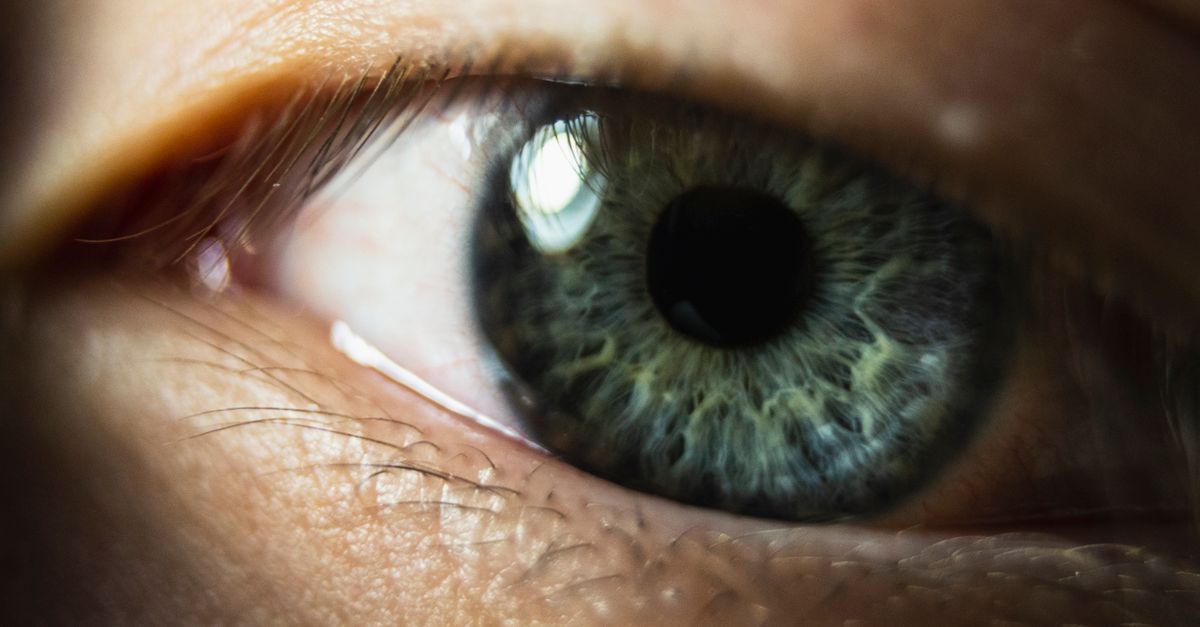
You might think everyone sees red the same way. But the person sitting next to you might see millions of colors you can’t distinguish—or struggle to tell red from green entirely. Human color vision isn’t one-size-fits-all. It’s a spectrum shaped by genetics, brain wiring, and the specific photoreceptors in your eyes.
The short answer
People see colors differently because they have variations in the light-sensitive cone cells in their eyes, differences in how their brains process color signals, or both. Some people lack certain cone types (color blindness), some have an extra type (tetrachromacy), and some experience neurological cross-wiring that adds color to other senses (synesthesia). Even among people with “normal” vision, genetic differences in photopigments create measurable variation in how colors appear.
Your eyes don’t see color—your brain does
Color doesn’t exist “out there” in the world. What exists is light at different wavelengths. Your eye’s job is to detect those wavelengths; your brain’s job is to interpret them as color.
Most humans have three types of cone cells in the retina, each tuned to different wavelengths of light:
- Short-wavelength (S) cones respond to blue light, peaking around 445 nanometers
- Medium-wavelength (M) cones respond to green light, peaking around 530 nm
- Long-wavelength (L) cones respond to red light, peaking around 560 nm
Your brain compares the signals from all three cone types. When you look at a ripe tomato, the L-cones fire intensely while the M-cones stay quiet—and your brain interprets that ratio as “red.” Change the ratio, and the color changes. This three-cone system is called trichromacy, and it’s why humans can distinguish roughly 10 million different color shades.
But not everyone has three functional cone types. And even among those who do, the details vary.
Color blindness: when cone types go missing
The most common reason people see colors differently is red-green color blindness, affecting about 8% of men and 0.5% of women. This happens when the genes that encode the red (L) or green (M) photopigments—called opsins—are mutated or absent.
Because these genes sit on the X chromosome, the condition is X-linked recessive. Men have one X chromosome, so a single mutated copy makes them color blind. Women have two X chromosomes, so they need mutations on both to be affected—much rarer.
The two most common forms are:
- Deuteranopia — missing the green opsin gene
- Protanopia — missing the red opsin gene
Here’s the crucial part: people with red-green color blindness still see colors. They’re not looking at a grayscale world. Their blue cones work perfectly fine, and they perceive yellows, blues, and many other hues. The problem is that without functional red and green cones, the brain can’t compare those two signals—so red and green look like similar shades of brown, tan, or gray.
Picture it this way: if you remove one instrument from an orchestra, you still hear music—but certain melodies become indistinguishable.
Debunking the black-and-white myth

A persistent misconception: people with color blindness see the world like an old black-and-white photograph. This is almost never true.
True complete color blindness—called monochromacy—exists, but it’s extraordinarily rare. Monochromats have lost all cone function and rely only on rod cells, which detect light intensity but not color. Their vision genuinely is grayscale, and they also suffer from poor visual acuity and extreme light sensitivity.
For the vast majority of people with color blindness, the world is full of color—just not the same palette you see. A red stop sign against green foliage might blend into an indistinct brown mass. Red text on a green background becomes nearly illegible. Autumn leaves lose their vivid red-orange spectrum and collapse into yellows and browns. But blue sky, yellow sunflowers, and purple grapes? Those remain distinct.
The confusion arises because red-green color blindness is often described as “not seeing red” or “not seeing green.” What it really means is “not distinguishing red from green.”
Tetrachromacy: when you see MORE colors
Now flip the script. What if you had four functional cone types instead of three?
Some women do. This condition, called tetrachromacy, occurs when a woman inherits two different versions of the red opsin gene—one on each X chromosome—and both remain functional. Instead of the standard red, green, and blue cones, tetrachromats have red, two variants of red, green, and blue.
The result? Tetrachromatic women can theoretically distinguish 100+ million color shades, compared to the ~10 million distinguishable by typical trichromats, according to research from the Neitz Lab at the University of Washington.
What does that look like in practice? Imagine looking at a paint swatch labeled “white.” You see one color. A tetrachromat might see three subtly different whites—variations in hue invisible to you. A sunset you’d describe as “orange fading to pink” might, to her, contain a dozen intermediate gradations you can’t name because you’ve never perceived them.
Estimates suggest 2-3% of women may be functional tetrachromats, though measuring this is tricky. You can’t ask someone, “Do you see more colors?” because they have no reference point—they’ve always seen the world this way. Researchers use color discrimination tests, asking subjects to distinguish between nearly identical hues. Tetrachromats consistently outperform trichromats, spotting differences others can’t.
One caveat: having four cone types doesn’t guarantee you use all four. The brain has to learn to process that fourth signal. Some genetic tetrachromats may not express the trait behaviorally, either because their brain never wired itself to interpret the extra information or because the two red opsins are too similar to provide useful contrast.
Even “normal” color vision varies

Here’s the subtler truth: even if you and your friend both have standard trichromatic vision, you probably don’t see colors identically.
Genetic variation means the exact wavelength sensitivity of each cone type shifts slightly from person to person. One person’s red cones might peak at 558 nm; another’s at 562 nm. That 4-nanometer difference changes how saturated or bright certain reds appear. Research in color vision shows red opsin sensitivity can vary across the population, and green opsin sensitivity varies as well, creating cumulative differences in individual color perception.
Add to that differences in macular pigmentation—the yellow carotenoid pigments in the center of your retina, which filter incoming light. Higher pigment density shifts color perception slightly toward the blue end of the spectrum. Lower density does the opposite.
The result: two people standing side-by-side, looking at the same paint chip, might genuinely disagree on whether it’s “greenish-blue” or “bluish-green”—and both are accurately reporting what they see.
This variation is continuous, not binary. There’s no sharp line between “normal” and “different.” We’re all somewhere on a spectrum of color-seeing ability, shaped by the particular opsins we inherited and the specific wiring of our visual cortex.
Synesthesia: when sounds have colors (and numbers do too)
Now we veer into stranger territory. Synesthesia is not a type of color blindness or a variation in color perception. It’s a completely separate neurological phenomenon where stimulation of one sense automatically triggers perception in another.
The most common forms involving color:
- Chromesthesia (sound-color synesthesia) — hearing a musical note or voice triggers the perception of a specific color. Middle C might always appear red; a car horn might flash yellow.
- Grapheme-color synesthesia — letters and numbers have inherent colors. The letter A is always blue. The number 7 is always green. These associations are consistent and involuntary.
Synesthetes don’t choose to see these colors—they just do, the way you don’t choose to hear sound when someone speaks. The experience is automatic, consistent over a lifetime, and often runs in families, pointing to a genetic component.
Research in Nature Neuroscience suggests synesthesia affects 2-4% of the population and arises from unusual cross-wiring between sensory regions of the brain. In most people, the “sound” area of the brain and the “color” area remain separate. In synesthetes, they’re linked—activating one activates the other.
Crucially, synesthesia is not a deficiency. Most synesthetes have entirely normal color vision. They’re not seeing different colors in the way a color-blind person might; they’re seeing additional colors triggered by non-visual stimuli. It’s an extra layer of perception, not a missing one.
Some synesthetes describe it as a gift—music becomes richer, numbers easier to remember. Others find it distracting. Either way, it’s fundamentally different from the cone-based variations we’ve been discussing.
FAQ
Is color blindness always inherited?
Mostly, yes. Red-green and blue-yellow color blindness are genetic, passed down through families via the X chromosome (red-green) or autosomal chromosomes (blue-yellow, which is much rarer—about 1 in 10,000 people). However, color vision deficiencies can also be acquired through eye disease, aging (the lens yellows over time, shifting color perception), or certain medications.
Can women be tetrachromats if they’re carriers of color blindness?
Yes—in fact, that’s exactly how tetrachromacy happens. A woman who inherits one normal red opsin gene and one mutated red opsin gene (making her a carrier for color blindness) can end up with both opsins functional but tuned to slightly different wavelengths. The result: four cone types instead of three. So the same genetic variation that causes color blindness in men can create enhanced color vision in women.
Do colorblind people know they’re colorblind?
Often not until they’re tested. If you’ve always seen red and green as similar shades, you have no reason to think your experience is unusual—you just learn that certain objects others call “red” look, to you, like brownish-gray. Many people discover their color blindness only when they fail a driver’s license vision test or struggle with color-coded charts at work.
Can anything fix color blindness?
Not yet. Glasses like EnChroma use filters to reduce wavelength overlap between red and green, making those colors appear more distinct for some users. They don’t restore the missing cone type or create normal color vision—they’re more like a workaround that enhances contrast. Gene therapy is in early research stages, with some success in animal models, but it’s not available for humans.
The next time you have a conversation about whether the ocean is more blue or green, or someone insists an autumn leaf is brown where you see orange-red, remember: you might both be accurately reporting what you see. The hardware behind human color vision—those three (or four, or two) types of cones and the brain interpreting their signals—varies more than we tend to assume. Some of us are missing instruments in the orchestra. Some have an extra violin. And some hear colors the rest of us will never see.
Written for general interest and accuracy-checked, but not a substitute for specialist sources.