
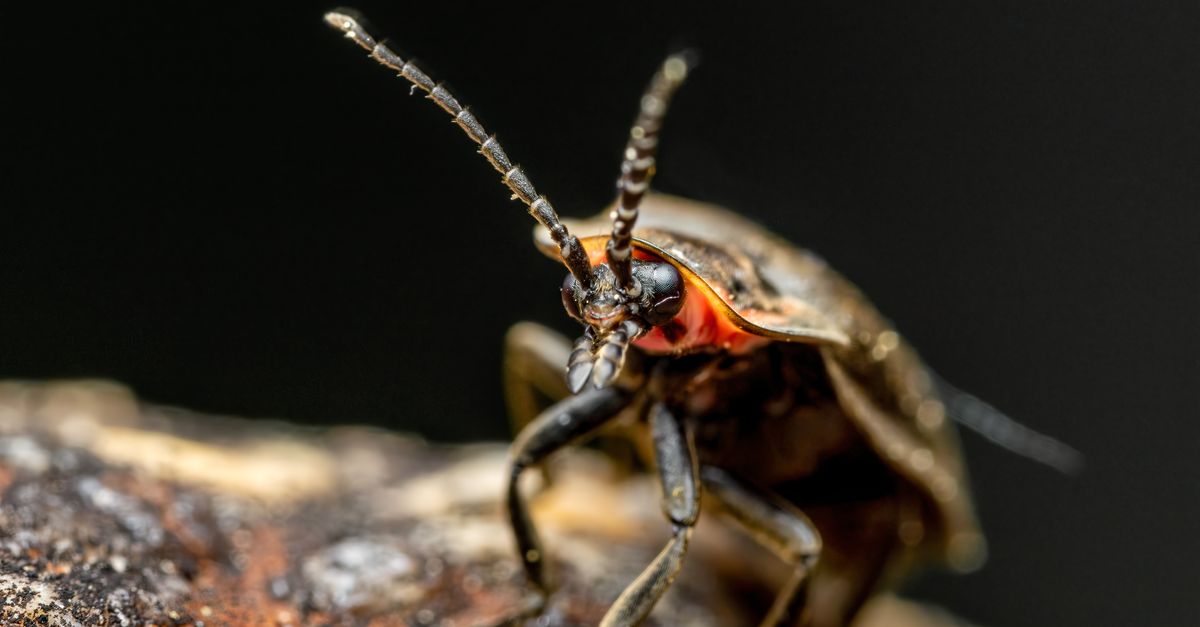
A firefly flashing in your backyard is running one of nature’s most efficient light-production systems—nearly all the energy converts to light, with minimal waste as heat. Your incandescent bulb manages about 5% by comparison. And the firefly does it with cold chemistry, turning the light on and off in milliseconds using a trick that took scientists decades to decode.
The short answer
Fireflies glow through a chemical reaction between a molecule called luciferin and an enzyme called luciferase. When oxygen floods specialized cells in the firefly’s abdomen, the reaction ignites, releasing yellow-green (or sometimes red) light with almost no heat waste. The firefly controls each flash by gating the oxygen supply with neural signals—a biological on-off switch that operates faster than you can blink.
The chemical flash
The firefly light chemistry depends on three players working in concert. Luciferin is a substrate molecule (a benzimidazole compound) that the firefly synthesizes in its light organ. Luciferase is the enzyme that catalyzes the reaction. Oxygen is the trigger—without it, nothing glows.
The reaction itself: luciferin + oxygen + ATP (cellular energy) + luciferase → oxyluciferin + light. The oxyluciferin is the “spent” form of luciferin, which the firefly then recycles back into fresh luciferin for the next flash.
This happens inside photocyte cells packed densely into the firefly’s abdomen—usually the fifth through seventh segments, depending on species. Surrounding the photocytes are tracheal tubes (insect breathing channels) that deliver oxygen on demand, and nerve endings that control the timing. When a National Geographic firefly expert dissects a light organ, what you see under magnification looks like a biological LED array: layers of light-producing cells backed by reflective tissue that bounces the glow outward.
How fireflies control the light
Here’s where it gets interesting. Fireflies don’t glow continuously—they flash in species-specific patterns, some as brief as a tenth of a second, others lasting two seconds or more. The precision matters: a male firefly flying at dusk emits his species’ exact flash code, and a female perched in the grass responds only if she recognizes the pattern. Get the timing wrong by half a second, and the signal fails.
The mechanism is an oxygen gate controlled by the nervous system. When the firefly decides to flash, the brain sends a nerve signal to the light organ. That signal triggers the tracheal tubes to open, flooding the photocytes with oxygen. Luciferin meets luciferase in the presence of oxygen, the reaction sparks, and light pours out. When the firefly wants to go dark, the nerve signal stops, the oxygen supply cuts off, and the glow extinguishes. The whole cycle—oxygen in, light on, oxygen out, light off—happens in milliseconds. This neural control is what allows fireflies to produce the complex morse-code flashes that entomologists have cataloged across roughly 2,000 species worldwide, according to research documented by the Smithsonian.
Why different species glow different colors

Most North American fireflies produce yellow-green light (around 560 nanometers), but some species glow deep yellow, orange, or even reddish (up to 680 nanometers). The color comes down to the structure of the luciferase enzyme and slight variations in the luciferin molecule itself. Different species have evolved subtly different versions of luciferase, and those structural tweaks change the wavelength of light the reaction produces.
In practical terms: a firefly’s flash color is part of its species identity. Females recognize their own species partly by flash pattern and partly by color. This is also why firefly populations in different regions sometimes show color variations even within the same species—local adaptation has tuned the enzyme over generations.
The larvae glow too, but for different reasons
Adult fireflies flash to find mates. But many firefly species’ larvae also glow—duller, more continuous, and not in patterns. The chemistry is the same (luciferin and luciferase), but the function is defense. Larval fireflies glow as a warning signal to predators: “I taste bad, don’t eat me.” It works. Birds and other predators learn quickly that a glowing larva means a mouthful of bitter toxins.
Not all firefly larvae glow, and not all glowing species have glowing larvae—it varies. But the larval glow is a reminder that bioluminescence evolved in fireflies not just for romance but as a multipurpose survival tool.
Why firefly light is so efficient

Bioluminescence converts nearly all chemical energy into light, with minimal heat production—this is why chemists call it “cold light.” The reaction is remarkably free of wasted energy. An incandescent bulb wastes roughly 95% as heat, while even modern LEDs achieve only 20–30% efficiency. Fireflies accomplish this through millions of years of evolutionary refinement, optimizing every step of the luciferin-luciferase reaction.
Ecologically, this matters. A firefly can flash dozens of times per minute on warm summer nights without overheating. The reaction doesn’t drain body temperature or require cooling mechanisms. It’s energetically cheap, which is why fireflies can afford to burn through ATP signaling to potential mates for hours at a stretch during mating season.
From an evolutionary perspective, this efficiency likely emerged because any heat-producing version of the reaction would have been selected against—wasted energy is wasted reproductive potential, and insects operating on tight energy budgets can’t afford inefficiency.
What it means for us
Firefly bioluminescence has inspired research into everything from medical imaging (luciferase is used as a reporter gene in lab experiments) to theoretical bioluminescent lighting systems. But in practice, we haven’t replicated firefly efficiency at scale. The chemistry works beautifully in a photocyte cell; scaling it to light a room is another matter.
What we have learned: cold-light chemistry is possible, and nature solved the problem millions of years before we started thinking about LEDs. The firefly’s light organ is a working proof-of-concept that near-perfect energy conversion is achievable with the right molecular architecture.
And in your backyard, firefly populations are declining—habitat loss, light pollution (which disrupts their mating signals), and pesticide use have crashed numbers across North America and Europe. If you see fireflies, you’re watching a chemical reaction that’s both ancient and increasingly rare.
FAQ
Why do fireflies glow?
Primarily to attract mates. Males fly and flash species-specific patterns; females perch and respond when they recognize the right signal. Some species also use bioluminescence as a predator deterrent.
What makes fireflies glow?
A chemical reaction between luciferin (a substrate molecule) and luciferase (an enzyme), catalyzed by oxygen and powered by ATP. The reaction produces light with almost no heat.
How long do fireflies glow?
Individual flashes last from 0.1 to 2 seconds, depending on species. The interval between flashes ranges from 1 to 9 seconds. Some species produce nearly continuous glows rather than discrete flashes.
Can fireflies glow without oxygen?
No. Oxygen is essential to the luciferin-luciferase reaction. Fireflies cannot produce light in anaerobic conditions.
Do all fireflies glow?
Most of the roughly 2,000 firefly species glow as adults, but a small number of “dark” species communicate via pheromones instead. Larval glow also varies by species.
Written for general interest and accuracy-checked, but not a substitute for specialist sources.