
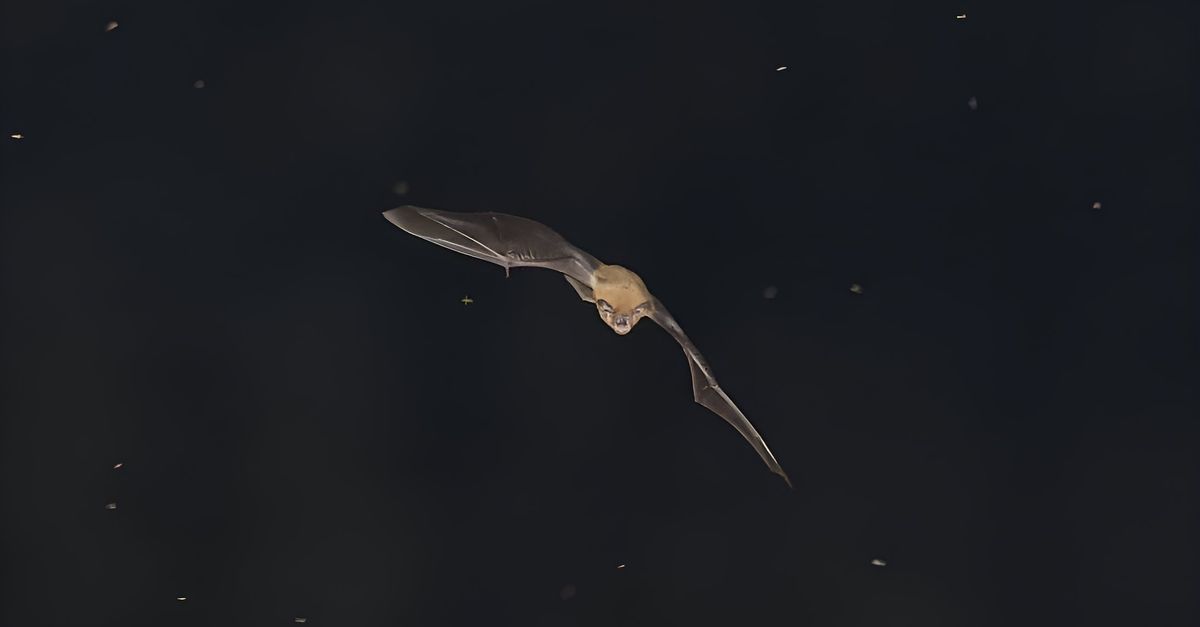
A big brown bat hunting insects over a pond can detect a mosquito in mid-flight from 15 meters away—in complete darkness. It does this by emitting 25–50 kHz ultrasonic calls up to 200 times per second and processing the returning echoes faster than you process what you’re seeing right now. That’s echolocation: an active sonar system that turns sound into a spatial map.
The short answer
Bats emit high-frequency sound pulses (typically 20–60 kHz, well above human hearing), listen for echoes bouncing off objects, and analyze the time delay, frequency shift, and intensity of those echoes to determine an object’s distance, size, speed, and texture. Their brains update this spatial map in under 1 millisecond—roughly 40 times faster than human visual processing.
How the three-step process works
Step one: Emission. The bat produces a rapid series of sound pulses from its larynx (voice box). Each pulse lasts just a few milliseconds. Insect-hunting bats emit calls in the 20–60 kHz range; fish-hunting bats like Noctilio leporinus use lower frequencies (10–40 kHz) that penetrate water better and detect surface ripples.
Step two: Echo return. Sound waves travel outward, bounce off insects, leaves, or cave walls, and return to the bat’s oversized, intricately shaped ears. The outer ear funnels echoes to the inner ear, where hair cells convert vibrations into neural signals.
Step three: Neural processing. Here’s where it gets extraordinary. The bat’s auditory cortex analyzes:
- Time delay between emission and echo (distance: closer objects = faster return)
- Doppler shift (frequency change reveals if the target is moving toward or away)
- Echo intensity (loudness indicates object size and material—hard surfaces reflect more strongly than soft ones)
- Frequency filtering (different frequencies return from different textures, letting bats distinguish a moth’s fuzzy body from a hard beetle shell)
According to research summarized by the Smithsonian, a bat’s brain processes this sensory flood in under 1 millisecond per update cycle. To put that in perspective: your visual system takes about 100 milliseconds to process what you’re looking at. A bat running echolocation updates its mental map of the world 40 times faster than you update yours through sight.
The feeding buzz: echolocation in overdrive

When a bat locks onto prey, its call rate accelerates dramatically. In open flight, a bat might emit 10–20 calls per second. As it closes in, the rate ramps up to 200+ calls per second—a rapid-fire staccato called the “feeding buzz.” This creates a slow-motion movie of the insect’s position, letting the bat predict its trajectory and intercept mid-flight. National Geographic notes that this temporal resolution is what allows bats to catch erratically flying moths that even birds struggle to track.
Why echolocation beats vision in the dark
Here’s the evolutionary trade-off most articles miss: bats didn’t lose vision and then evolve echolocation as a workaround. They optimized for echolocation because it’s superior to vision in their niche—dense forests, caves, and nighttime skies where light is scarce and obstacles are everywhere.
Most bat species see in color. They have functional eyes with dichromatic or trichromatic vision similar to dogs. But they’ve de-prioritized detailed visual acuity in favor of ultrasonic hearing. Why? Because echolocation works in absolute darkness, penetrates clutter (leaves, branches) better than light, and tracks fast-moving prey with remarkable precision. A bat’s auditory system can detect and distinguish tiny changes in echo characteristics—a sensitivity that would require sophisticated imaging hardware to replicate.
The “bats are blind” myth likely arose because bats don’t need to look where they’re flying. You’d seem blind too if you could navigate a pitch-black room at 30 mph by listening to echoes.
Echolocation vs. other animal navigation systems

Bat echolocation is just one solution to the navigation problem. Different animals have evolved wildly different systems depending on their environment:
| Navigation System | Example Animal | How It Works | Strength |
|---|---|---|---|
| Active echolocation | Bats, toothed whales | Emit sound, listen for echoes | Works in darkness/murky water; detects moving prey |
| Passive magnetic sensing | Whales, sea turtles | Detect Earth’s magnetic field | Works across oceans; no energy cost per reading |
| Sun-compass navigation | Monarch butterflies | Track sun position + circadian clock | Reliable over thousands of miles in open sky |
| Electric field sensing | Sharks, platypuses | Detect bioelectric fields from muscle contractions | Pinpoints hidden prey in murky water |
Echolocation is active: the bat must emit energy (sound) to receive information. Magnetic or celestial navigation is passive: the animal reads environmental cues without broadcasting. The trade-off? Active systems like echolocation give real-time, high-resolution spatial data but cost energy and can be jammed by environmental noise (wind, rain, other bats calling). Passive systems are “free” but offer less temporal precision.
Interestingly, toothed whales like dolphins also echolocate, but in water—a denser medium where sound travels roughly 4.3 times faster than in air. Sperm whales produce extraordinarily powerful echolocation clicks, among the loudest sounds in the ocean, to navigate and hunt in the deep. Bats and whales evolved echolocation independently—a textbook case of convergent evolution solving the same problem (navigate without light) in different environments.
The limits: what echolocation can’t do
Echolocation isn’t magic. Heavy rain scatters sound waves, degrading echo quality. Dense foliage creates a chaotic mess of overlapping echoes. Wind distorts call frequency. Bats compensate by calling more frequently and flying slower, but there’s a practical ceiling: most bats hunting insects have an effective detection range of 3–15 meters, depending on prey size.
And echolocation doesn’t work through solid barriers. A bat can’t “see” through a wall the way some people imagine—it hears only what bounces back from the surface facing it. This is why bats sometimes collide with windows: smooth glass reflects echoes in unpredictable directions, creating phantom openings.
FAQ
Are bats really blind?
No. Most bat species have functional vision and see in color, though not in fine detail. They’ve simply evolved to rely on echolocation as their primary sense for hunting and navigation because it outperforms vision in darkness and cluttered environments.
What frequency do bats use for echolocation?
It varies by species. Most insect-eating bats emit calls between 20–60 kHz. Fish-hunting bats use lower frequencies (10–40 kHz) to detect water surface ripples. All of these are ultrasonic—above the ~20 kHz upper limit of human hearing.
Can humans hear bat echolocation?
Not usually. Bat calls operate above the human hearing range. However, some bats emit audible harmonics or lower-frequency calls, so you might hear faint clicks or chirps if a bat is calling nearby—but you’re hearing the edge of the sound, not the full ultrasonic pulse.
Do other animals use echolocation?
Yes. Toothed whales (dolphins, sperm whales), some shrews, oilbirds, and certain swiftlet species all echolocate. Each has evolved frequency ranges and call structures suited to their environment—water, dense jungle, or dark caves.
Echolocation is evolution’s answer to a design challenge: how do you navigate, hunt, and avoid obstacles when there’s no light? For bats, the solution was to weaponize hearing—turning the auditory cortex into a real-time spatial computer that processes sound faster than we process sight. Other animals solved this puzzle through magnetic sensing, sun-compass navigation, or electric field detection—each elegant in its own way.
Written for general interest and accuracy-checked, but not a substitute for specialist sources.